
Many data analyst candidates fail technical interviews not because they lack coding skills, but because they treat SQL as a syntax test rather than a problem-solving engine. Senior data leaders and hiring managers do not just want to see if you can write a JOIN; they want to see if you can use database tables to diagnose a sudden drop in product conversions, track customer churn patterns, or calculate user lifetime value.
Shifting your focus from abstract coding exercises to real, scenario-based business logic is the fastest way to stand out as a business-minded analyst. This guide dives deep into complex, scenario-based SQL interview questions modeled after genuine operations in e-commerce, software-as-a-service (SaaS), and digital marketplaces.
Quick Answer: How to Approach Scenario-Based SQL Questions
When faced with a complex scenario-based query, do not write code immediately. Follow this structured execution framework:



Crack Data Analyst Interviews with Real Company Questions
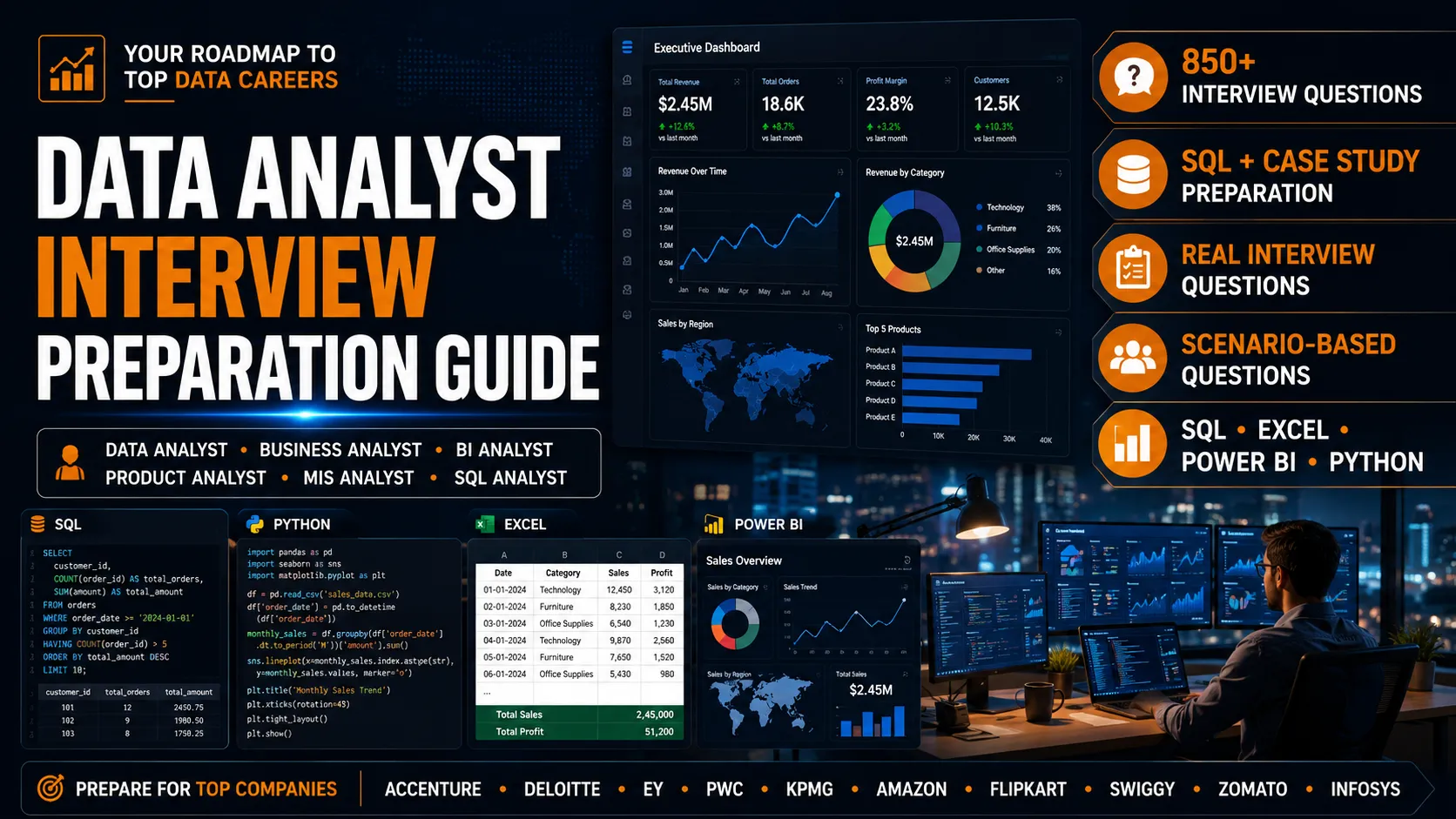
Access 850+ curated Data Analyst interview questions covering SQL, Excel, Power BI, Python, Business Analytics & Case Studies — inspired by interviews at top companies and MNCs. Designed to help freshers and professionals prepare smarter for real interviews.
Inspired by Interview Trends Across
Business Scenario 1: E-Commerce Cart Abandonment Tracking
The Problem Situation
An e-commerce business wants to track its checkout funnel efficiency. Specifically, the product manager needs to identify users who added items to their shopping cart but did not complete a purchase within the same session.
The Question
Given an events table that tracks user actions, write an efficient SQL query to calculate the daily Cart Abandonment Rate.
Table Schema: events
- event_id (INT)
- user_id (INT)
- session_id (VARCHAR)
- event_name (VARCHAR) — 'view_item', 'add_to_cart', 'checkout_start', 'purchase'
- created_at (TIMESTAMP)
Quick Definition & Formula
The cart abandonment rate is calculated as:
The Solution Query
WITH session_activity AS (
    SELECT
        DATE(created_at) AS activity_date,
        session_id,
        MAX(CASE WHEN event_name = 'add_to_cart' THEN 1 ELSE 0 END) AS added_to_cart,
        MAX(CASE WHEN event_name = 'purchase' THEN 1 ELSE 0 END) AS purchased
    FROM events
    GROUP BY DATE(created_at), session_id
)
SELECT
    activity_date,
    SUM(added_to_cart) AS total_cart_add_sessions,
    SUM(CASE WHEN added_to_cart = 1 AND purchased = 0 THEN 1 ELSE 0 END) AS abandoned_sessions,
    ROUND(
        100.0 * SUM(CASE WHEN added_to_cart = 1 AND purchased = 0 THEN 1 ELSE 0 END)
        / NULLIF(SUM(added_to_cart), 0), 2
    ) AS cart_abandonment_rate_pct
FROM session_activity
WHERE added_to_cart = 1
GROUP BY activity_date
ORDER BY activity_date DESC;Interviewers love this structure because it tests conditional aggregation (MAX(CASE WHEN...)). Instead of joining the events table to itself (which slows down execution on billion-row tables), this solution flattens the log data into a single row per session inside a CTE, making it highly scalable.
Business Scenario 2: SaaS Customer Retention & Monthly Churn
The Problem Situation
A subscription-based SaaS startup needs to track customer churn. The executive team wants a clear, month-over-month view showing how many active users cancelled their plans, indicating a loss in recurring revenue.
The Question
Write a query using a subscriptions table to identify monthly active customers and calculate the MOM Churn Rate. A user is considered churned in Month N if they were active in Month N-1 but do not have an active subscription in Month N.
Table Schema: subscriptions
- subscription_id (INT)
- user_id (INT)
- start_date (DATE)
- end_date (DATE) — NULL if the subscription is still active
The Solution Query
WITH RECURSIVE months AS (
    SELECT MIN(DATE_TRUNC('month', start_date)) AS month_date FROM subscriptions
    UNION ALL
    SELECT month_date + INTERVAL '1 month' FROM months
    WHERE month_date < ( SELECT MAX(DATE_TRUNC('month', start_date)) FROM subscriptions )
),
monthly_active_users AS (
    SELECT
        m.month_date,
        s.user_id
    FROM months m
    JOIN subscriptions s
      ON s.start_date <= m.month_date
     AND (s.end_date IS NULL OR s.end_date > m.month_date)
    GROUP BY m.month_date, s.user_id
),
retention_matrix AS (
    SELECT
        month_date,
        COUNT(user_id) AS active_users,
        LAG(COUNT(user_id)) OVER (ORDER BY month_date) AS previous_month_active_users,
        COUNT(CASE WHEN user_id NOT IN (
            SELECT user_id FROM monthly_active_users mau2 WHERE mau2.month_date = mau1.month_date + INTERVAL '1 month'
        ) THEN 1 END) AS churned_users_this_month
    FROM monthly_active_users mau1
    GROUP BY month_date
)
SELECT
    month_date,
    active_users,
    previous_month_active_users,
    churned_users_this_month,
    ROUND(
        100.0 * churned_users_this_month / NULLIF(active_users, 0), 2
    ) AS monthly_churn_rate_pct
FROM retention_matrix
ORDER BY month_date DESC;This test requires advanced window functions (LAG()) and deep understanding of temporal bounds (handling NULL end dates). It proves to the interviewer that you can model continuous customer states over time.
Crack Data Analyst Interviews with Real Company Questions
Access 850+ curated Data Analyst interview questions covering SQL, Excel, Power BI, Python, Business Analytics & Case Studies — inspired by interviews at top companies and MNCs. Designed to help freshers and professionals prepare smarter for real interviews.
Inspired by Interview Trends Across
Business Scenario 3: Identifying Fraud and High-Frequency Transactions
The Problem Situation
A fintech platform notices a spike in coordinated financial fraud. Bad actors are executing rapid transactions across multiple accounts within incredibly tight windows to exploit systemic clearing delays.
The Question
Identify any user who has completed two or more distinct financial transfers within 10 minutes of each other. Output the user ID, transaction IDs, and the exact time gap.
Table Schema: transactions
- transaction_id (INT)
- user_id (INT)
- amount (DECIMAL)
- transaction_time (TIMESTAMP)
The Solution Query
WITH sequential_transactions AS (
    SELECT
        user_id,
        transaction_id AS current_tx_id,
        transaction_time AS current_tx_time,
        LEAD(transaction_id) OVER (PARTITION BY user_id ORDER BY transaction_time) AS next_tx_id,
        LEAD(transaction_time) OVER (PARTITION BY user_id ORDER BY transaction_time) AS next_tx_time
    FROM transactions
)
SELECT
    user_id,
    current_tx_id,
    next_tx_id,
    current_tx_time,
    next_tx_time,
    (next_tx_time - current_tx_time) AS transaction_time_gap
FROM sequential_transactions
WHERE next_tx_time IS NOT NULL
  AND next_tx_time <= current_tx_time + INTERVAL '10 minutes'
ORDER BY user_id, current_tx_time;Notice the use of LEAD() OVER (PARTITION BY user_id ORDER BY transaction_time). This isolates the calculation to individual user timelines. Using analytic functions prevents the database from running a costly cross-join scenario that breaks down during real-time fraud monitoring updates.
Common Strategy Mistakes Candidates Make in Business Cases
| Mistake | Operational Danger | Code Fix Strategy |
|---|---|---|
| Hardcoding Dates | Breaks automated dashboards when data refreshes next month. | Use dynamic time features like CURRENT_DATE or DATE_TRUNC(). |
| Dividing by Zero | Triggers fatal runtime execution errors on empty days. | Wrap denominators with NULLIF(column_name, 0) to gracefully return null. |
| Inefficient Self-Joins | Triggers full table scans and crashes database engines. | Substitute self-joins with analytical window functions (LEAD, LAG, ROW_NUMBER). |
| Overlooking Timezones | Aggregates global sales data incorrectly, skewing metrics. | Clarify data timezone offsets and explicitly cast timestamps using AT TIME ZONE. |
Don't just memorize. Practice with Industry Experts.
Theory only gets you so far. Book a 1:1 mock interview with Senior Data Analysts from top product companies and get actionable feedback.
Best Practices for Scenario-Based SQL Interviews
Map Out Constraints Early
Ask the interviewer if data entries could be duplicated, if timestamps are in UTC, and how edge cancellations should be categorized.
Verify Granularity
Confirm if the final output needs to be at a daily, monthly, or individual user level before writing the base aggregation tables.
Explain Scalability
Mention that while your written solution works cleanly, creating proper indices on high-volume filtering keys (like user_id or created_at) protects production servers.
Final Thoughts
Succeeding in a modern mid-level or senior data analyst interview requires showing that you care deeply about what the data represents. By practicing these scenario-based SQL layouts, you prove you can walk into an organization, examine logging tables, and extract the underlying truth about user habits and business health.
Frequently Asked Questions (FAQ)
Unlike pure syntax questions that ask you to simply join two tables or find duplicate rows, scenario-based questions embed technical issues within a complex business situation, such as assessing payment funnel conversion or spotting platform fraud.
Common Table Expressions (CTEs) break highly complex business requirements down into logical, chronological blocks that can be read top-to-bottom. This approach simplifies troubleshooting and makes optimization significantly easier for senior review teams.
Always use the NULLIF(expression, 0) function in your denominator. If the expression evaluates to zero, SQL treats it as a NULL value instead of throwing a divide-by-zero database execution failure, returning a clean NULL result instead.
Conditional aggregation uses commands like SUM(CASE WHEN status = 'completed' THEN 1 ELSE 0 END). It lets you safely compute counts, statuses, and performance percentages for multiple distinct metrics in a single pass over a table, avoiding complex joins.
Use a standard GROUP BY when you want to collapse individual data records into a single row summary metric. Use a window function when you want to compute running trends, ranks, or intervals across individual entries while maintaining each row's unique identity.
Retention modeling requires isolating user cohorts based on their initial signup period, then tracking subsequent active sessions across later months by joining those cohorts back to historical activity tables.
LAG pulls a data column value from a previous row in the query configuration, while LEAD looks forward and pulls a data column value from a subsequent record down the timeline.
A cross-join pairs every row from the primary dataset with every row in the secondary dataset. For large databases, this creates an unmanageable explosion of processing rows that degrades system performance.
Use COALESCE(column_name, 'Unknown') to clean up missing labels. This gives you a clear default label so your grouped business calculations don't drop rows with incomplete inputs.
Practice identifying the core transaction events behind popular digital services. For example, consider how you would query an app like Uber to find peak ride times, or analyze Spotify data to flag when a user skips songs sequentially.