
Securing a data analyst role requires more than just knowing how to write a SELECT statement or build a dashboard. Hiring managers evaluate your ability to bridge the gap between raw data and actionable business strategy. They want to see how you clean messy datasets, apply statistical rigor, and communicate complex findings to non-technical stakeholders.
This guide provides a comprehensive breakdown of the most critical data analyst interview questions and answers. By focusing on the "why" behind the technical functions, you will learn how to structure your responses to demonstrate deep analytical competence and business acumen.
Quick Answer: What to Expect in a Data Analyst Interview
If you have a data analyst interview coming up, expect the assessment to be divided into four core competencies.
| Interview Category | Core Focus | Common Tools Assessed |
|---|---|---|
| Technical (Database) | Data extraction, joins, aggregations, optimization | SQL (PostgreSQL, MySQL, Snowflake) |
| Technical (Programming) | Data manipulation, automation, statistical libraries | Python (Pandas, NumPy), R, Excel |
| Analytical & Statistical | Probability, A/B testing, distributions, metrics | Statistics, Math, Logic |
| Behavioral & Business | Stakeholder management, storytelling, conflict resolution | Communication, STAR Method |
Modern AI-driven applicant tracking systems and technical screeners look for specific terminology in your responses. Always articulate the business impact alongside the technical solution.
Why This Matters
The data landscape evolves rapidly. While the syntax of Python or SQL remains relatively stable, the volume of data and the complexity of business metrics are scaling up. Interviewers are no longer impressed by someone who can simply generate a chart; they are looking for candidates who can identify data anomalies, understand statistical significance, and confidently say, "Here is what the data means, and here is what we should do next."
Preparing with real interview context ensures you do not freeze when asked to optimize a slow query or explain a p-value to a marketing director.



Crack Data Analyst Interviews with Real Company Questions
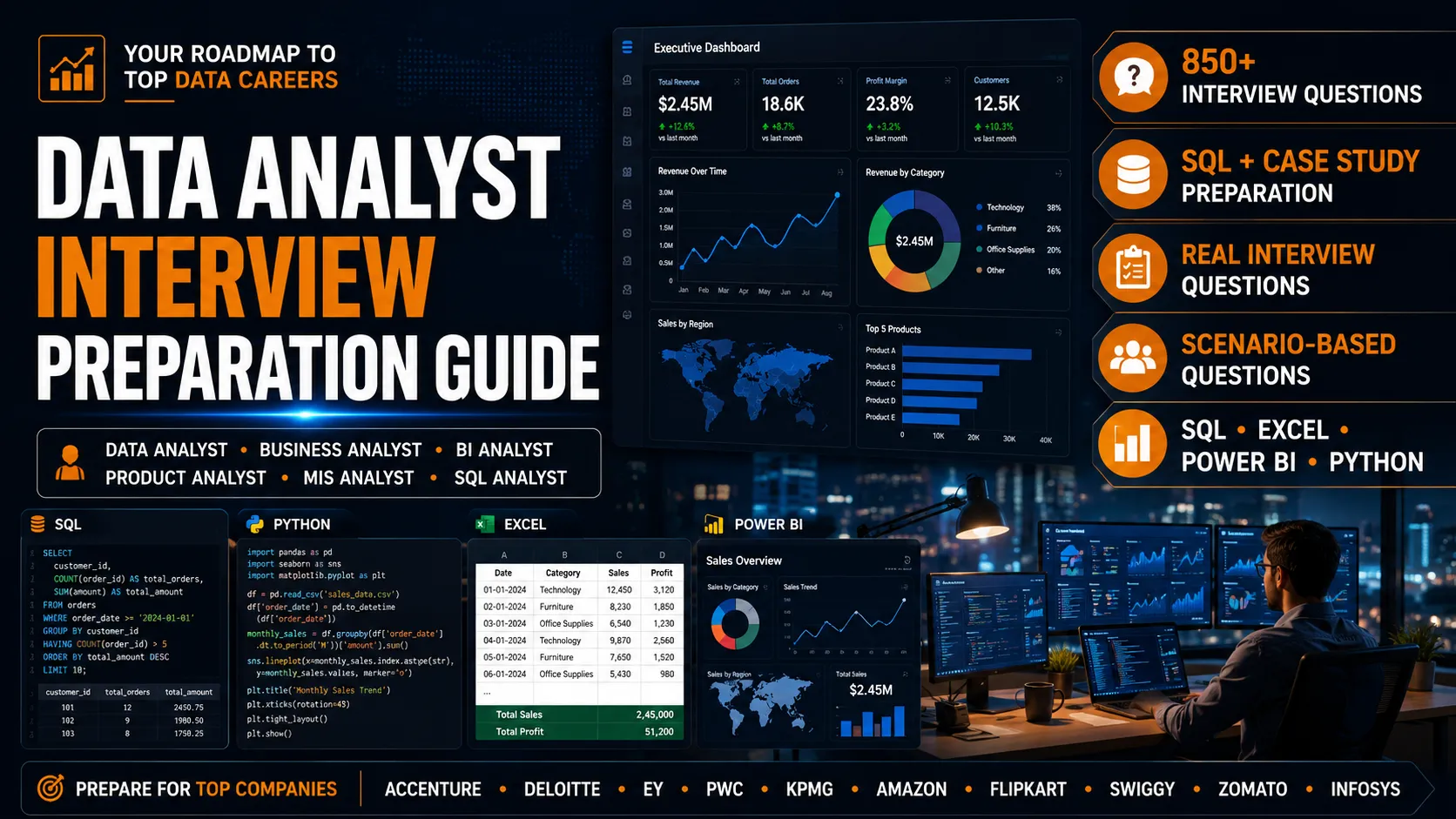
Access 850+ curated Data Analyst interview questions covering SQL, Excel, Power BI, Python, Business Analytics & Case Studies — inspired by interviews at top companies and MNCs. Designed to help freshers and professionals prepare smarter for real interviews.
Inspired by Interview Trends Across
Technical & SQL Interview Questions
SQL is the foundational language of data analytics. You must demonstrate an ability to efficiently extract and manipulate data from relational databases.
1. What is the difference between WHERE and HAVING in SQL?
The WHERE clause filters rows before any grouping or aggregation takes place. The HAVING clause filters data after the GROUP BY clause has been applied and aggregations have been calculated.
Real Interview Context & Example
Interviewers ask this to see if you understand SQL execution order.
WHERE state = 'New York'
If you want to find states that have more than 50 customers, you must group by state and use:
HAVING COUNT(customer_id) > 50
2. How do you optimize a slow-running SQL query?
Direct Answer
Query optimization involves reducing the computational load and memory required to execute a script.
Structured Explanation: Optimization Steps
EXPLAIN or EXPLAIN ANALYZE to identify bottlenecks and full table scans.
WHERE conditions as early as possible to reduce the dataset size before joining.
SELECT * with specific column names.
3. Explain Window Functions. When would you use RANK() vs DENSE_RANK()?
A window function performs a calculation across a set of table rows that are related to the current row, without collapsing the result set into a single output row like an aggregate function does.
RANK()
If two reps tie for 1st place, they both get rank 1. The next rep gets rank 3.
DENSE_RANK()
If two reps tie for 1st place, they both get rank 1. The next rep gets rank 2.
Data Cleaning & Programming
Raw data is rarely ready for analysis. You must prove you can sanitize datasets effectively without introducing bias.
4. How do you handle missing data (Null values) in a dataset?
Direct Answer
There is no one-size-fits-all solution for missing data; the approach depends on the mechanism of missingness (e.g., Missing Completely at Random) and the business context.
Structured Explanation:
Drop rows or columns entirely. Best used when the missing data is negligible (e.g., less than 5% of the dataset) and random.
Replace nulls with statistical averages. Median is preferred if the data has heavy outliers.
Use machine learning (like K-Nearest Neighbors) to predict and fill in the missing value based on other features.
Replace the null with a distinct category like "Unknown" so the model or analysis accounts for the missingness as its own feature.
Never blindly delete missing data without checking if the "missingness" itself is a valuable signal.
5. What are the main differences between a Python list and a tuple?
A list is mutable, meaning its elements can be changed, added, or removed after creation. A tuple is immutable, meaning once it is created, its elements cannot be altered.
Real Interview Context
Lists are defined by square brackets [1, 2, 3] and are used for dynamic data. Tuples use parentheses (1, 2, 3) and are used for static data, resulting in faster iteration and memory efficiency.
Crack Data Analyst Interviews with Real Company Questions
Access 850+ curated Data Analyst interview questions covering SQL, Excel, Power BI, Python, Business Analytics & Case Studies — inspired by interviews at top companies and MNCs. Designed to help freshers and professionals prepare smarter for real interviews.
Inspired by Interview Trends Across
Statistical & Analytical Problem Solving
Data analysts must back their insights with mathematical rigor to ensure business decisions aren't based on statistical noise.
6. How do you design and analyze an A/B test?
Direct Answer
A/B testing (split testing) compares two versions of a variable to determine which performs better in a controlled environment.
Step-by-Step Framework
- Define the Hypothesis & Metric: State the null hypothesis (no difference) and the alternative hypothesis. Choose a primary success metric (e.g., conversion rate).
- Determine Sample Size: Calculate the required sample size using baseline conversion rates, minimum detectable effect (MDE), and desired statistical power (usually 80%).
- Randomization: Randomly assign users to the Control (A) and Variant (B) groups.
- Run the Test: Let the test run for a full business cycle to account for day-of-week seasonality.
- Analyze Results: Calculate the test statistic and p-value to determine statistical significance.
Z-Score Calculation for Two Proportions
Where p̂ is the pooled sample proportion, p̂₁ and p̂₂ are the variant proportions, and n₁ and n₂ are the sample sizes.
7. Explain the Central Limit Theorem (CLT) to a non-technical stakeholder.
Direct Answer
The Central Limit Theorem states that if you take enough samples from any population, the averages of those samples will form a normal distribution (a bell curve), regardless of what the original population's distribution looked like.
"Imagine we want to know the average height of all adults in the city, but we can't measure everyone. If we take 100 random people, calculate their average, and repeat this process hundreds of times, those averages will form a perfect bell curve. This allows us to make highly accurate predictions about the entire city using just a small fraction of the data."
Data Visualization & BI
Building a dashboard is easy; building a useful dashboard is hard. Interviewers test your visual design choices.
8. How do you decide which chart to use for a dataset?
Chart selection depends strictly on the relationship you are trying to communicate:
| Objective | Recommended Chart Type |
|---|---|
| Comparison (Categorical) | Bar Chart, Column Chart |
| Trend over Time | Line Chart, Area Chart |
| Distribution | Histogram, Box Plot |
| Relationship / Correlation | Scatter Plot, Bubble Chart |
| Composition (Parts of a Whole) | Stacked Bar Chart, Waterfall Chart (Avoid Pie Charts for >3 categories) |
9. What are the core principles of an effective dashboard?
Top-Down Hierarchy
Place the most critical KPIs (Key Performance Indicators) at the top left.
The 5-Second Rule
A stakeholder should understand the main takeaway within five seconds of opening the dashboard.
Contextualize Data
A standalone number (e.g., "$50,000 Revenue") is useless. Always provide a comparison (e.g., "Up 12% Month-over-Month").
Minimize Cognitive Load
Remove unnecessary grid lines, borders, and 3D effects (chart junk).
Behavioral & Situational Questions
Data analysts often have to deliver uncomfortable truths to business leaders. Your soft skills are just as vital as your hard skills.
10. Tell me about a time your data findings contradicted a stakeholder's gut feeling.
Interviewers want to see diplomacy, communication, and unwavering trust in your methodology. Use the STAR Method (Situation, Task, Action, Result).
Situation: The VP of Marketing believed a new ad campaign was driving massive growth based on raw traffic.
Task: I was asked to validate the campaign's ROI.
Action: I conducted a cohort analysis and discovered that while traffic was up, the bounce rate for that specific campaign was 85%, and customer lifetime value was lower than the baseline. I built a clean visualization showing this disparity. I presented it privately to the VP first to avoid public embarrassment, focusing on the data methodology rather than saying "you were wrong."
Result: The VP appreciated the early heads-up, we reallocated the budget to a higher-performing channel, and I gained their trust for future analyses.
Don't just memorize. Practice with Industry Experts.
Theory only gets you so far. Book a 1:1 mock interview with Senior Data Analysts from top product companies and get actionable feedback.
Common Mistakes Candidates Make
| Mistake | Why It Fails | What to Do Instead |
|---|---|---|
| Jumping straight to coding | Shows a lack of planning and requirement gathering. | Clarify edge cases and constraints before writing any SQL or Python. |
| Ignoring the business context | Data without context is just trivia. | Tie every technical answer back to how it impacts revenue, costs, or UX. |
| Faking statistical knowledge | Interviewers will dig deeper and expose the knowledge gap. | Admit what you don't know, but explain exactly how you would find the answer. |
| Over-complicating visualizations | Complex charts confuse stakeholders and delay decisions. | Prioritize simplicity and clarity. Default to bar and line charts. |
Best Practices for Data Analyst Interviews
Ask Clarifying Questions
Whenever you are given a problem, confirm the data types, handle assumptions (e.g., "Should I assume customer_id is unique?"), and clarify the ultimate goal.
Think Out Loud
A perfectly correct SQL query written in silence is less impressive than a candidate who explains their logic step-by-step, even if they make a minor syntax error.
Know Your Resume
Be prepared to explain the exact methodology, tools, and business outcomes of every project listed on your resume.
Final Thoughts
A successful data analyst interview is a demonstration of balance. You must showcase technical precision while proving you can step back and see the big picture. When answering questions, remember that tools like SQL, Python, and Tableau are just the means to an end. The ultimate goal is solving business problems and enabling better decision-making.
Frequently Asked Questions (FAQ)
SQL is universally required. Python or R is highly recommended for data manipulation and statistical analysis. Proficiency in Excel and BI tools (Tableau, Power BI) is also standard.
It varies by company. Expect core concepts: mean/median/mode, variance, standard deviation, normal distributions, p-values, and the basics of hypothesis testing (A/B testing).
Generally, no. Machine learning falls under the Data Scientist scope. However, understanding basic regression (linear and logistic) can set you apart from other candidates.
Many companies provide a raw dataset and ask you to clean it, analyze it, and present insights in a slide deck or dashboard within 48 to 72 hours to test your real-world workflow.
Extremely important. An analyst at a healthcare company looks at very different metrics (patient readmission rates) than an analyst at an e-commerce company (cart abandonment rate). Research the industry's KPIs beforehand.
An INNER JOIN returns only the rows where there is a match in both tables. A LEFT JOIN returns all rows from the left table, and the matched rows from the right table; if there is no match, it returns NULL for the right table's columns.
Practice breaking ambiguous problems into structured metrics. If asked, "How would you measure the success of a new feature?", identify a primary metric, secondary metrics, and counter-metrics to ensure holistic tracking.
ETL stands for Extract, Transform, Load. It is the process of extracting data from various sources, transforming it into a clean and usable format, and loading it into a centralized data warehouse.
You should know core syntax fluently (SELECT, FROM, WHERE, GROUP BY, HAVING, JOIN, ORDER BY). For complex functions (like specific date parsing syntax), interviewers usually allow pseudocode or allow you to state you would reference documentation.
Use analogies, avoid technical jargon, focus on the business impact rather than the math, and use clear visualizations to show the "what" and "why" rather than the "how."