
The demand for skilled Data Analysts continues to grow across startups, multinational corporations, consulting firms, product companies, and service-based organizations. Whether you are a fresher preparing for your first analytics role or an experienced professional aiming for career growth, mastering common Data Analyst interview questions can significantly improve your chances of success.
This comprehensive guide covers the top Data Analyst interview questions and answers that recruiters frequently ask during technical and business-focused interviews.
Why Data Analyst Interviews Matter
Companies rely on data-driven decision-making to improve customer experiences, optimize operations, and increase profitability. During interviews, hiring managers assess your:
The following questions represent some of the most frequently asked Data Analyst interview questions in 2026.



Crack Data Analyst Interviews with Real Company Questions
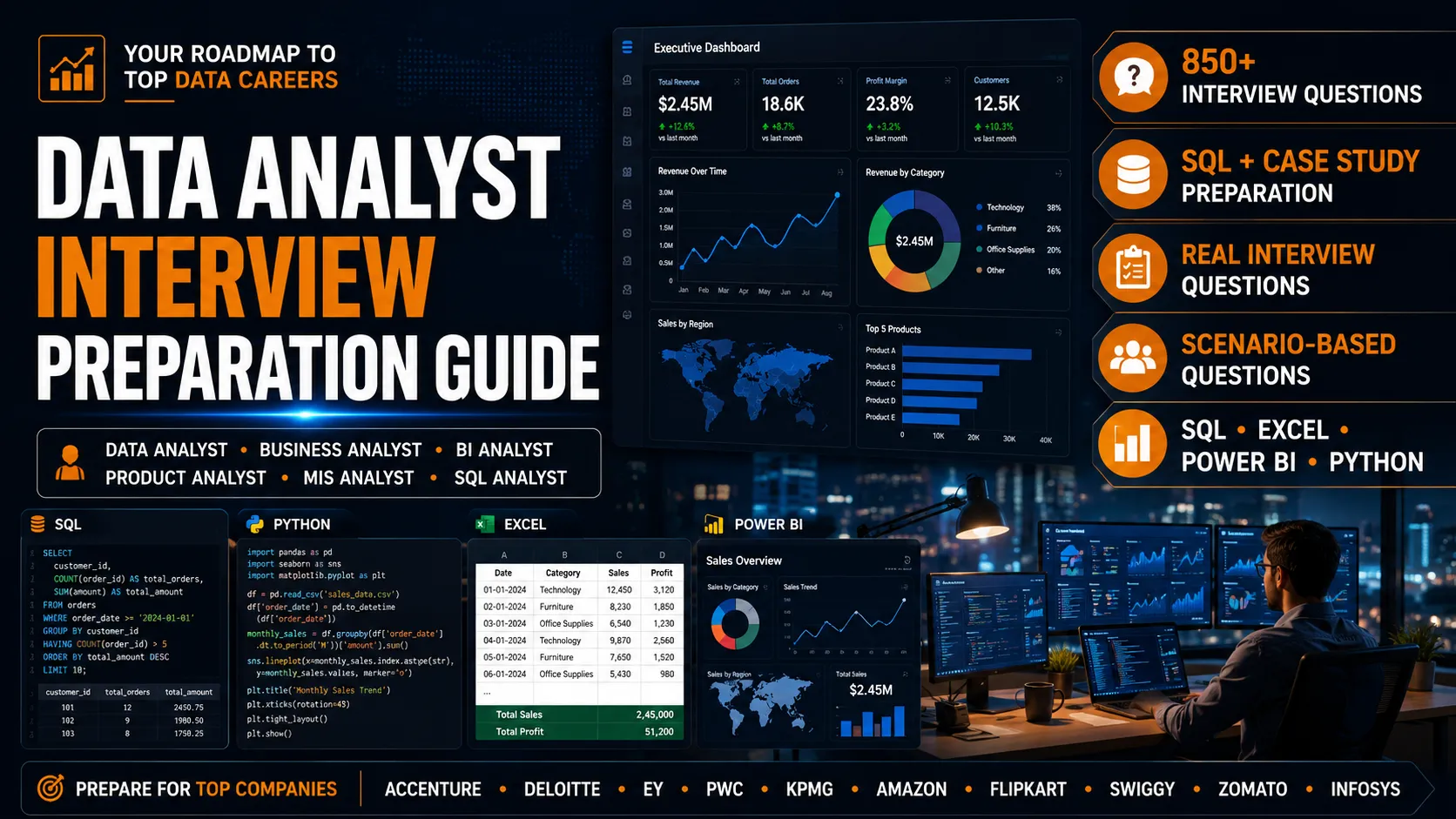
Access 850+ curated Data Analyst interview questions covering SQL, Excel, Power BI, Python, Business Analytics & Case Studies — inspired by interviews at top companies and MNCs. Designed to help freshers and professionals prepare smarter for real interviews.
Questions Inspired by Interviews at Top Companies





















1. Tell Me About Yourself
"Hi, my name is Rahul. I have a background in Computer Science and developed a strong interest in data analytics through projects involving SQL, Excel, Power BI, and Python. I enjoy transforming raw data into actionable insights that help businesses make informed decisions. I am currently seeking an opportunity where I can apply my analytical skills while continuing to learn and grow in the field of data analytics."
Why Interviewers Ask This Question
- Assess communication skills
- Understand your professional background
- Evaluate confidence and presentation
- Determine role alignment
Common Mistakes to Avoid
- Sharing unnecessary personal information
- Giving a lengthy introduction
- Speaking without a clear structure
2. What Is Data Analysis?
Answer
Data analysis is the process of collecting, cleaning, transforming, and interpreting data to discover meaningful insights that support business decision-making.
Organizations use data analysis to:
Typical Data Analysis Process
Why This Question Is Asked
Interviewers want to evaluate your understanding of the complete data analytics lifecycle.
3. What Is the Difference Between Data Analysis and Data Analytics?
Answer
Although these terms are often used interchangeably, they have distinct meanings.
Data Analysis
- Focuses on historical data
- Identifies patterns and trends
Data Analytics
- Includes predictive and prescriptive methods
- Forecasts future outcomes
- Recommends actions
4. What Are KPIs?
Answer
KPIs (Key Performance Indicators) are measurable metrics used to evaluate business performance against strategic objectives.
Common Business KPIs
- Revenue Growth
- Customer Retention Rate
- Conversion Rate
- Customer Acquisition Cost (CAC)
- Monthly Active Users (MAU)
E-commerce KPI Examples
- Revenue
- Orders
- Conversion Rate
- Average Order Value (AOV)
Why Interviewers Ask This Question
They want to assess your business acumen and ability to connect data insights with organizational goals.
Crack Data Analyst Interviews with Real Company Questions
Access 850+ curated Data Analyst interview questions covering SQL, Excel, Power BI, Python, Business Analytics & Case Studies — inspired by interviews at top companies and MNCs. Designed to help freshers and professionals prepare smarter for real interviews.
Questions Inspired by Interviews at Top Companies
5. What Is Data Cleaning and Why Is It Important?
Answer
Data cleaning is the process of identifying and correcting inaccurate, incomplete, duplicate, or inconsistent data before analysis.
Common Data Cleaning Activities
The following entries may represent the same customer:
- John Smith
- john smith
- JOHN SMITH
Without standardization, analysis results may be inaccurate.
Importance of Data Cleaning
Poor-quality data can lead to:
- Incorrect reports
- Faulty business decisions
- Misleading insights
- Reduced operational efficiency
6. What Is the Difference Between INNER JOIN and LEFT JOIN?
Answer
SQL joins are fundamental concepts for Data Analysts.
INNER JOIN
Returns only matching records from both tables.
| INNER JOIN Result (CustomerID) |
|---|
| 1 |
| 2 |
LEFT JOIN
Returns all records from the left table and matching records from the right table.
| LEFT JOIN Result (CustomerID) |
|---|
| 1 |
| 2 |
| 3 |
Why Interviewers Ask This Question
- Test SQL fundamentals
- Assess database knowledge
- Evaluate practical querying skills
7. What Is a Dashboard?
Answer
A dashboard is a visual representation of business data that enables stakeholders to monitor KPIs and make informed decisions quickly.
Benefits of Dashboards
- Real-time monitoring
- KPI tracking
- Trend analysis
- Performance measurement
- Faster decision-making
Popular Dashboard Tools
 Power BI
 Tableau
 Looker Studio
Example Sales Dashboard Metrics
8. What Is the Difference Between Mean and Median?
Answer
Both are measures of central tendency used in statistics.
Mean
The arithmetic average of all values.
10, 15, 20, 25, 100
Mean = (10 + 15 + 20 + 25 + 100) ÷ 5
= 34
Median
The middle value in a sorted dataset.
10, 15, 20, 25, 100
Median
= 20
Why Interviewers Ask This Question
- Evaluate statistical knowledge
- Assess data interpretation skills
9. What Is Power BI?
Answer
Power BI is a business intelligence and data visualization platform developed by Microsoft that enables users to create interactive reports and dashboards.
Key Features of Power BI
- Data integration
- Data transformation
- Interactive visualizations
- Dashboard creation
- Report sharing
Core Components
Why Interviewers Ask This Question
To assess your experience with business intelligence tools and reporting solutions.
Don't just memorize. Practice with Industry Experts.
Theory only gets you so far. Book a 1:1 mock interview with Senior Data Analysts from top product companies and get actionable feedback.
10. Describe a Data Analytics Project You Have Worked On
"I developed a sales performance dashboard using Excel and Power BI to track revenue trends and monitor regional performance. After cleaning and transforming the data, I created interactive visualizations that highlighted underperforming regions and emerging sales trends. The dashboard improved reporting efficiency and enabled stakeholders to make faster, data-driven decisions."
Why Interviewers Ask This Question
- Assess practical experience
- Evaluate problem-solving skills
- Understand business thinking
- Measure communication effectiveness
Common Mistakes
- Focusing only on tools
- Ignoring business impact
- Providing vague explanations
Final Data Analyst Interview Preparation Tips
To succeed in Data Analyst interviews, focus on strengthening the following skills:
Technical Skills
- • SQL
- • Excel
- • Power BI
- • Python
- • Statistics
Business Skills
- • KPI Understanding
- • Business Analysis
- • Problem Solving
- • Data Storytelling
Soft Skills
- • Communication
- • Presentation
- • Stakeholder Management
The most successful candidates combine technical expertise with strong business understanding and effective communication.
Frequently Asked Questions (FAQ)
SQL, Excel, Power BI, Python, Statistics, Data Visualization, and Business Analysis are among the most important skills for Data Analysts.
Yes. SQL is one of the most commonly tested skills in Data Analyst interviews because analysts frequently work with databases.
Power BI and Tableau are the most widely used business intelligence tools for dashboard creation and reporting.
Freshers should focus on SQL, Excel, Statistics, Power BI, Python basics, and project-based learning to demonstrate practical experience.
Projects involving dashboards, sales analysis, customer analytics, KPI tracking, forecasting, and business reporting are highly valuable.